
- calendar_today November 3, 2026
University names attract attention when families compare schools. The practical value lies in what students can actually do with a relationship: meet a representative, learn about a program, receive portfolio advice or apply through a defined pathway. Those are different experiences, and each helps at a different point in a student's planning.
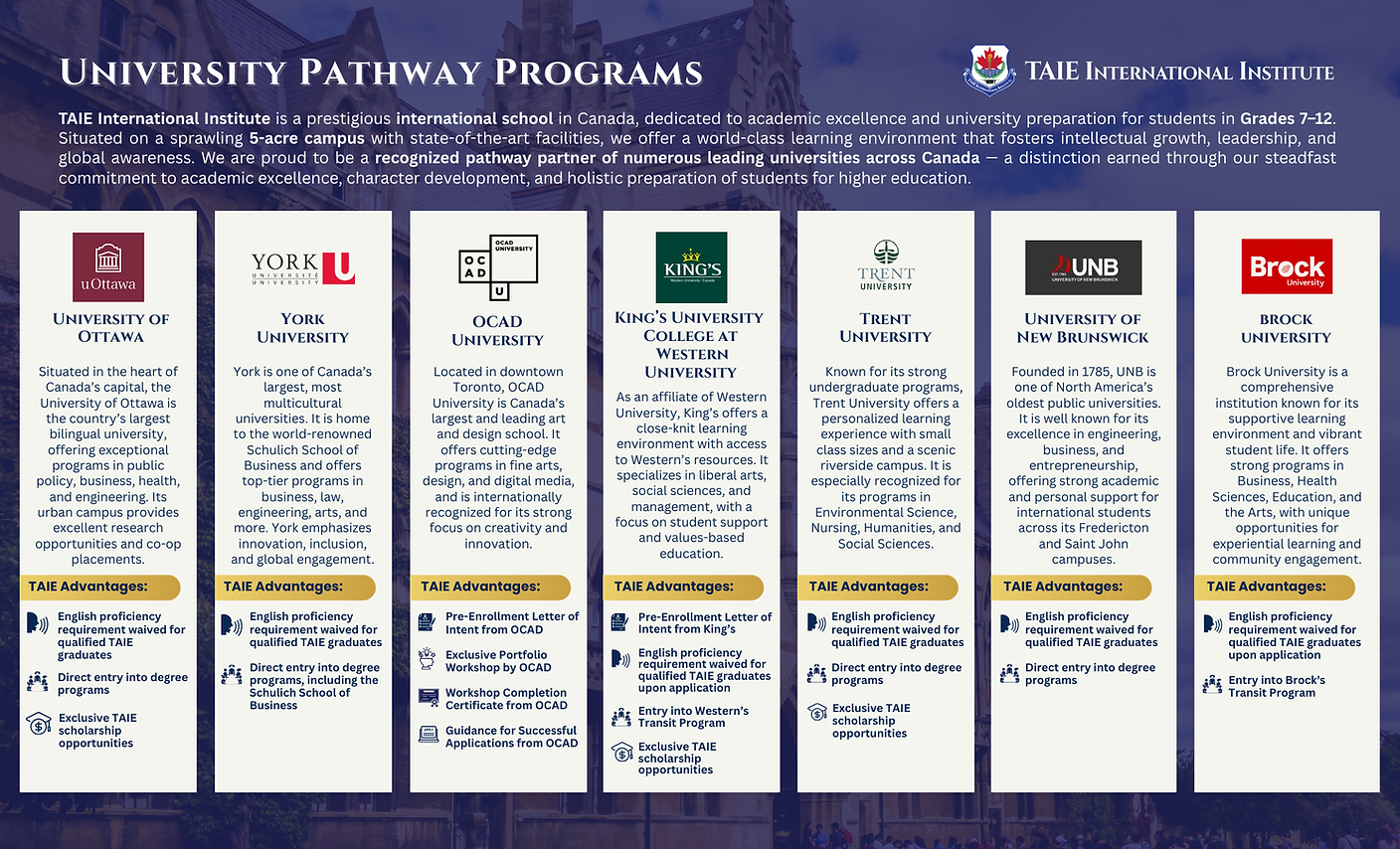
TAIE International Institute, a Canadian private school serving Grades 7–12 in Thornhill, describes several kinds of university connections. Its university visits include presentations and workshops that let students ask questions about programs. For a student still exploring, a visit can make a distant institution more concrete. They can compare course content, campus life and entry requirements with their own interests.
A visit opens a conversation
A representative's campus visit gives students direct access to information. The most useful questions are specific: Which secondary-school courses are required? Does the program ask for a portfolio or supplemental application? How are applicants assessed? How should an international student prepare? TAIE's public University Fair coverage describes students meeting representatives from 33 universities and colleges in 2026. The scale broadens the choices students can compare in one school setting.
These events can also help families refine a shortlist. A student drawn to business may discover that two programs with similar names emphasize different subjects. A student interested in art may find that a portfolio is as important to planning as course grades. That is where the school's guidance team can help turn a conversation into a course and application plan.
A workshop develops a skill
TAIE's university-visits information describes portfolio workshops with institutions including OCAD University. A workshop has a different purpose from a general presentation: it can help a student understand how to assemble and discuss work for a creative program. Families can ask whether a workshop is available in the student's area of interest, when it takes place and what preparation students should bring.
TAIE also describes university-related learning through its academic programs. The connection to school study matters. A strong relationship becomes useful when students can apply the information to the courses they choose, the skills they practice and the deadlines they follow.
A pathway gives qualified students defined terms
TAIE's York University partnership announcement describes a direct pathway for qualified graduates, including stated academic and English-language conditions for eligible programs. A family should read those terms alongside York's application guidance for the student's intended degree. Programs can set additional requirements. The pathway is most useful when it becomes part of an individual plan early enough for the student to choose the right courses and prepare a complete application.
For families assessing a school, three questions bring the relationship into focus: What opportunity can my child use this year? Who helps them follow up? What requirements apply to the program they want? TAIE's position as a Grades 7–12 school is to connect its university relationships with the student's day-to-day learning, guidance and application preparation.
For a second view of any university relationship, families can consult the OUAC undergraduate application guide and the intended university's own admissions page. OUAC advises applicants to confirm current program requirements and deadlines with the university; a school partnership does not replace that check.
About TAIE International Institute
TAIE International Institute serves Grades 7–12 on a five-acre campus in Thornhill, Ontario. It combines academic study, guidance and connections with higher education to help students prepare for university.
Sponsored content prepared with information supplied by TAIE International Institute.




