
- calendar_today August 17, 2025
Stretching the Imagination, Light on Drama
Marvel’s The Fantastic Four: First Steps is a visually attractive, slightly goofy reboot of the studio’s first family of superheroes. Stuffed with strong performances (particularly from Pedro Pascal and Ebon Moss-Bachrach), it wallows in a 1960s-era Marvel look with a big wink. But while First Steps is often charming, it never amps up the suspense or emotional stakes to make it pop.
Marvel producer Kevin Feige described it as “a no-homework-required movie.” After an especially busy year of Marvel movies, it’s nice to see one that doesn’t demand a working knowledge of all the multiverses, one-episode cameos, and latest spin-offs. First Steps takes a new stab at introducing Reed Richards, Sue Storm, Johnny Storm, and Ben Grimm, without the burden of a heavily embroidered continuity from past live-action movies. It doesn’t need any. The film is content to be basic—and, in some cases, too basic.
It begins with a talk show, hosted by Mark Gatiss, that narrates through exposition (a favorite writerly sin) how the Fantastic Four became who they are. Four years ago, the foursome’s scientific space mission was beamed out by cosmic radiation that altered their DNA. Reed (thoughtfully and goofily played by Pedro Pascal) found himself able to stretch his body like rubber. Vanessa Kirby’s Sue has powers of invisibility and force projection. Joseph Quinn’s Johnny is the Human Torch with the power to set himself aflame and fly. Ebon Moss-Bachrach’s Ben Grimm was transformed into the rock-covered superhero known as The Thing.
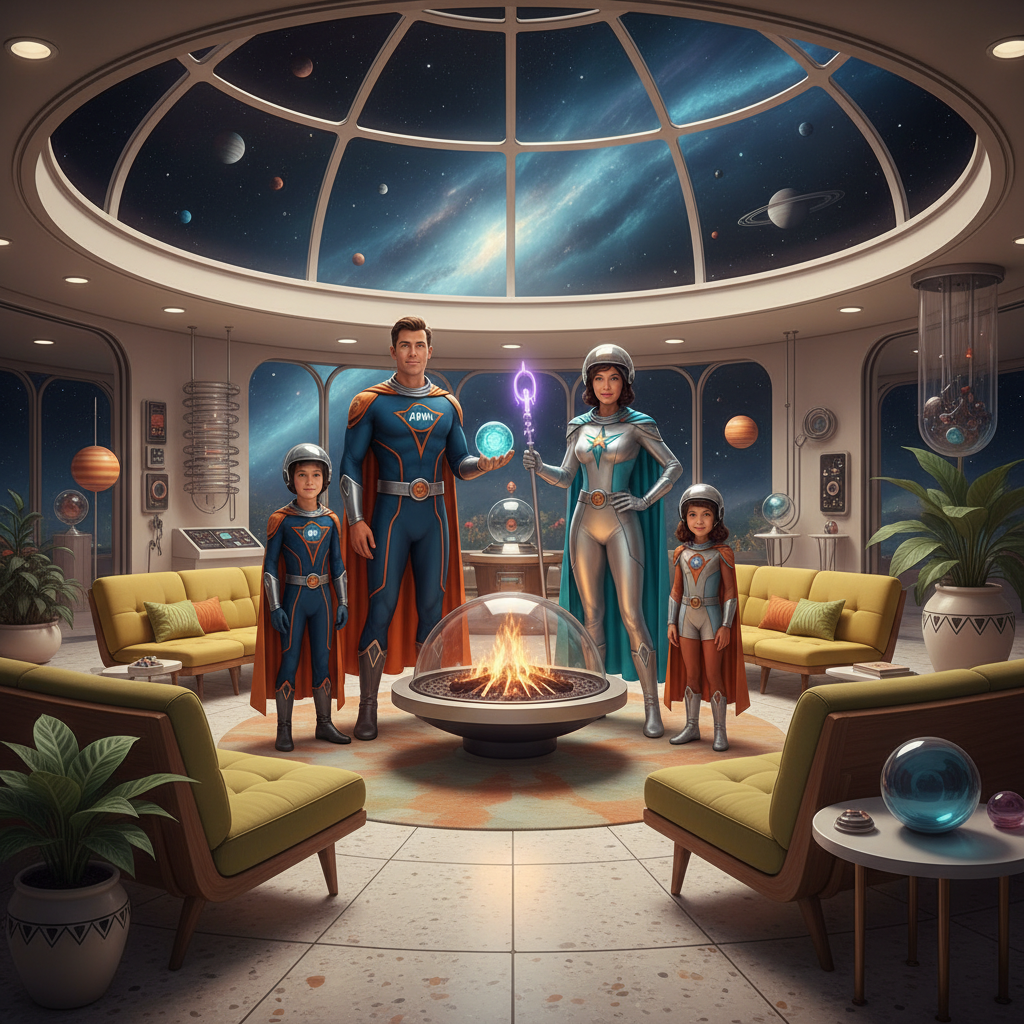
They now live as a family in what appears to be a mid-century modern space compound, with flying cars, walls covered in chalkboard equations, and a toddler-sized robot named H.E.R.B.I.E. to help with domestic tasks. The whole world of First Steps is pure retro-futurism: the square boxes for television screens, no smartphones, and a bright retro ’50s optimism in its design sensibility. If The Jetsons and Lost in Space had a baby that then began reading Marvel comic books, it would be this film.
If the style is cuddly, the story never accelerates. The film’s dominant theme is family—the primal nuclear-family relationship among the four leads. Sue learns in the opening minutes that she is pregnant, and Reed’s reaction is a wonderful combo of worried and sweet. In one funny montage, he instructs H.E.R.B.I.E. to child-proof not just their home but also their science laboratory. Johnny and Ben also have sibling-style bantering conflict and comic-dynamic, but also clearly accept their roles as surly but dutiful older uncles.
But their domestic happiness is interrupted by a galactic hitchhiker who shows up in their new neighborhood. Galactus is a hulking, armored man with glowing eyes and even more luminescent, radiating power tubes for a torso. He has a shockingly plausible jaw and alien vocalics when he speaks, making him simultaneously credible and cartoonish. He is coming to Earth to eat the planet as a snack, and to prepare for the meal, he’s sent a herald: a thin, rubber-bodied humanoid with silver skin played by Julia Garner in motion-capture. We also get to see her costume in full, with an unsettling cowl and face mask. The Silver Surfer slinks and swoops into the movie with a sleek and scary menace, though she quickly becomes an object of (male) fascination (and, for Johnny, infatuation).
But even with this looming menace, the action is surprisingly tame. As the four heroes give chase to Galactus through deep space and try to fend off the Surfer, the actual special effects resemble the look of the rest of the film: swooshes of light, orange flame tails, and general popping. The film’s big third-act problem—Sue going into labor in the middle of the deep-space rescue mission—also comes across more as a hallucination than a high-stakes “oh no!” moment. It’s a curiously low-key showdown: birth and the end of the world, seen through a psychedelic lava lamp color palette.
It’s a fun mix, but the tones undercut each other. There are emotional moments in the film, but they’re often overpowered by the general pastel soft-focus look. The stakes never quite feel high, even when Earth is at stake. It’s a kid-friendly adventure tale more than an urgent blockbuster.
The Fantastic Four: First Steps is good-natured and well-acted, but not especially dramatic or edge-of-your-seat. It’s highly accessible and ultra-nostalgic, as well as very sincere. But for those who want more Avengers-level thrills, or are looking for a meatier superhero fare, First Steps might feel more like a sugary energy supplement than a main-course Marvel offering.