
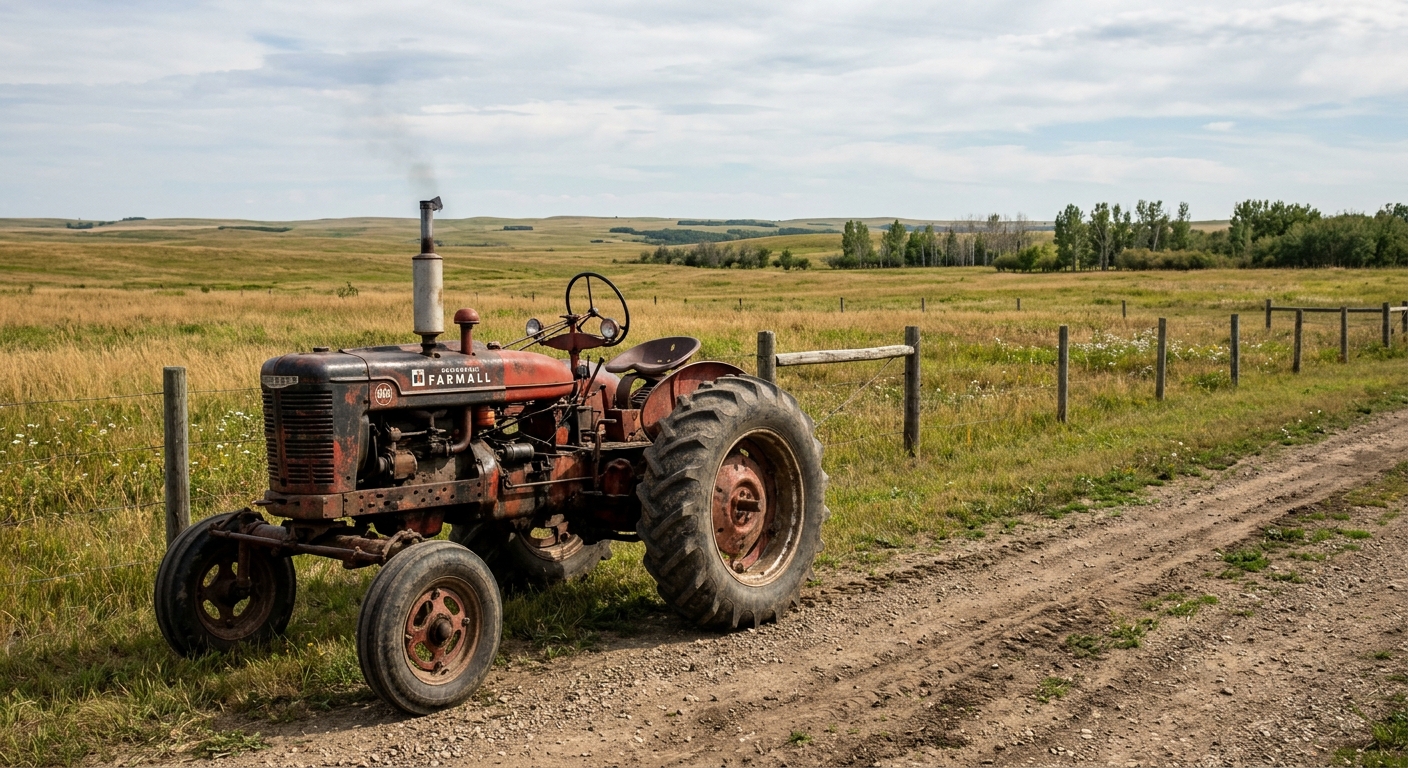
AI-generated illustration; not a photograph of the reported event.
- calendar_today October 29, 2026
Ursa Ag's All-Mechanical Tractor Breaks Industry Norms
A small agricultural service shop in Bowden, Alberta, is making headlines with a unique approach to farm machinery. Ursa Ag has designed and assembled an all mechanical tractor, attracting attention from both local producers and interested buyers around the world. In an agricultural sector increasingly reliant on high-tech solutions, this low cost tractor emphasizes reliability, simplicity, and ease of repair.
Building Simplicity: The Story Behind the Ursa Tractor
Doug Wilson, owner of Ursa Ag, began developing the all mechanical Ursa 150 tractor four years ago at his Bowden-based parts and agricultural servicing outlet. The inspiration came from a customer whose son wanted to continue the family farm but struggled with the affordability and complexity of equipment. Wilson's solution was simple farm equipment that forgoes complex electronics and computer codes, allowing straightforward repairs and maintenance that require only basic mechanical skills.
Meeting a Demand for Easy Repair Tractors
The UA1804 model, assembled in Bowden, is built from widely available components: new parts like the cab, chassis, and manual transmission are combined with a rebuilt motor and custom pieces. The result is an agricultural machine designed for straightforward maintenance—a clear contrast to new models often tied to manufacturer service contracts. Wilson notes he has fielded inquiries from across North America and as far as South Africa, with one unit shipped to Florida.
Reception Among Farmers and Ranchers
Farmers struggling with farm equipment costs and maintenance have welcomed the all mechanical tractor. Rudy Metsmaker, a cattle rancher near Rimbey, Alberta, was among the first to purchase an Ursa model. He appreciates the basic farm tractor for its straightforward operation, saying it fits the needs of his 900-acre operation at a reasonable price point.
Wilson has been inundated with messages from both farmers and non-farmers praising the simple design and reliability. "We get a lot of communication from non-farmers who just say, 'We love what you're doing,'" Wilson shared, adding that compliments have come alongside serious business inquiries.
Low-Tech, Low-Cost: Pricing and Production
The Ursa tractor is priced competitively: the 150-horsepower model sells for $130,000, while a 260-horsepower unit is available for special order at $200,000. According to Wilson, this translates to approximately $850 per horsepower for the base model—a pricing metric not seen in the sector for a decade. These models are tailored for cattle ranches and heavy general duty rather than acreage or hobby farms. Wilson's small team of 10 employees plans to increase production to 50 units next year.
Mechanical Tractor Demand in a Shifting Market
With new agricultural machinery becoming more powerful and reliant on electronic automation, some farmers are turning to older or easy repair tractors to manage costs and maintenance. Industry data shows Canadian tractor sales dropped 15 percent in September, and combine sales fell 38 percent, as high diesel prices, steep interest rates, and instability in commodity markets slow large equipment purchases.
Many producers, like Olds-area farmer Jason Jackson, run a mix of old and new machinery to balance reliability and cost. Jackson notes that older models are less complex and easier to maintain independently, reducing reliance on dealerships and computerized diagnostics. This trend is echoed by Craig Barton of Medicine Hat Tractor Salvage, who observes continued demand for basic farm tractor parts and repairs among small and mid-sized producers.
Looking Ahead for Ursa Ag and Farm Tractor Reliability
Wilson remains focused on making practical, dependable agricultural machinery that gives producers more control over tractor maintenance and repairs. He aspires to reach "a tractor [that] could run for 10 years without breaking," acknowledging that absolute reliability may not be realistic for any machine, but sees ongoing improvement as his company's goal.
Source: cbc.ca.




