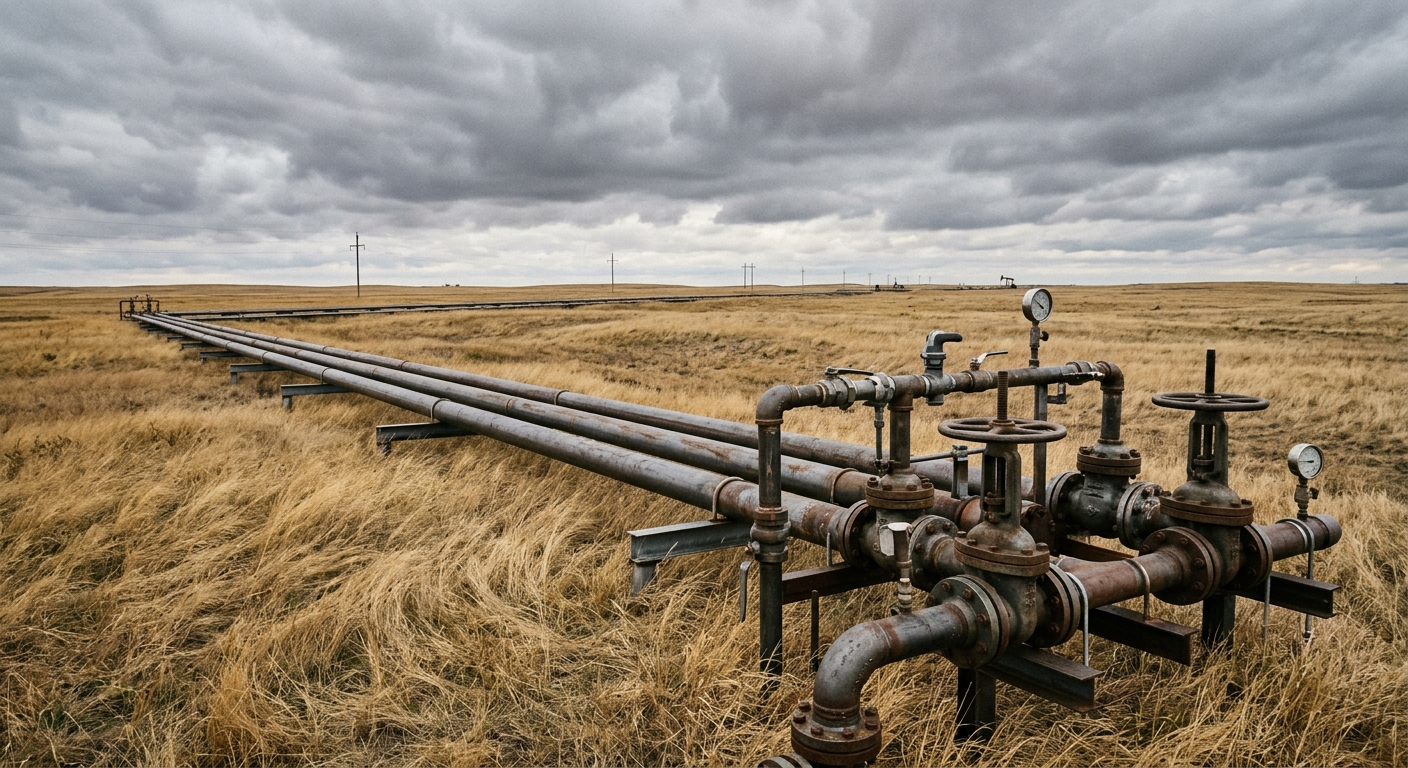
AI-generated illustration; not a photograph of the reported event.
- calendar_today October 28, 2026
Canadian Crude Oil Trading at a Growing Discount
Although global oil prices have surged into triple digits this year, Canadian crude oil is selling at an increasingly steep discount compared to the North American benchmark. The price gap between Western Canadian Select (WCS) and West Texas Intermediate (WTI), typically around $12 USD per barrel, has recently widened to about $20 or $25. This trend is attributed to several compounding factors, with no clear short-term solution in sight.
Factors Behind the Increasing WCS Discount
The war between Iran and the U.S. has driven global oil prices higher, pushing WTI to approximately $100 per barrel. However, Canadian producers are primarily subject to WCS pricing, which reflects additional discounts relative to WTI. Al Salazar, head of macro research at Enverus, explains that rising tanker shipping rates and increased flows of Venezuelan oil to the U.S. are intensifying the price differential felt by Canadian producers.
"While the sexy headlines are saying ‘triple-digit oil, way to go,’ Canadian producers are subject to WCS pricing," Salazar said. This means that not only are Canadian producers paying more to ship oil to offshore markets, but they are also facing stiffer competition for refining capacity, particularly in the U.S. Gulf Coast.
Pipelines and Market Access Remain Key Challenges
Richard Masson, former CEO of the Alberta Petroleum Marketing Commission, notes that Canadian producers fare better when they have diversified options for sending their product and more shipping capacity. However, pipeline networks are presently near full capacity, and U.S. demand has softened due to some refineries being offline and increased competition from Venezuelan imports. "As we are growing our production pretty much continuously in the oilsands, if we don't have enough market access, new pipelines or other things, then we end up in a problem because the pipes can’t keep up with the growth in production," Masson warned.
He also acknowledged that solutions such as the expansion of Enbridge’s network and the Trans Mountain pipeline will take time to affect the market. Another proposed solution, the Pacific Link pipeline to the West Coast, would allow greater access to Asian oil markets but would not be operational until at least 2032.
Growing Interest from Asian Oil Markets
While the differential with the WTI benchmark remains wide, Canadian crude oil is securing a premium in Asian markets. According to Masson, global instability from Middle East and Russian suppliers, along with higher tanker rates and increased Venezuelan exports to the U.S., make Canadian crude more appealing to Asia. The completion of the Trans Mountain expansion is expected to further support exports to Asian buyers by allowing diluted bitumen to be shipped via tankers more efficiently.
Despite this positive development, the volume of Canadian oil currently reaching Asian destinations is insufficient to compensate for reduced U.S. market share.
Impacts on Alberta's Economy and Oil Export Value
Charles St-Arnaud, chief economist for Servus Credit Union, stated that while the Trans Mountain expansion has previously helped keep the WCS-WTI gap from growing, the current lack of short-term fixes means the province could see several billion dollars less in economic surplus. Even though St-Arnaud anticipates strong royalties for Alberta, they are expected to be lower than they might have been if the price differential were narrower.
He noted that the average consumer is unlikely to notice direct changes at the gas pump due to the oil price differential. Still, "It’s really reduced the value of oil exports. We’re getting less money per barrel than we would hope to have, and that can be quite important." Nevertheless, prices per barrel remain attractive compared to recent years, so the outlook is less than optimal but still relatively positive for the sector.
Looking Ahead
The Canadian oil industry continues to contend with ongoing challenges, including pipeline capacity, shipping costs, and competition from other global suppliers. Without new infrastructure or immediate market solutions, the oil price differential may persist, shaping the economic reality for producers and the provincial economy alike.
Source: cbc.ca.