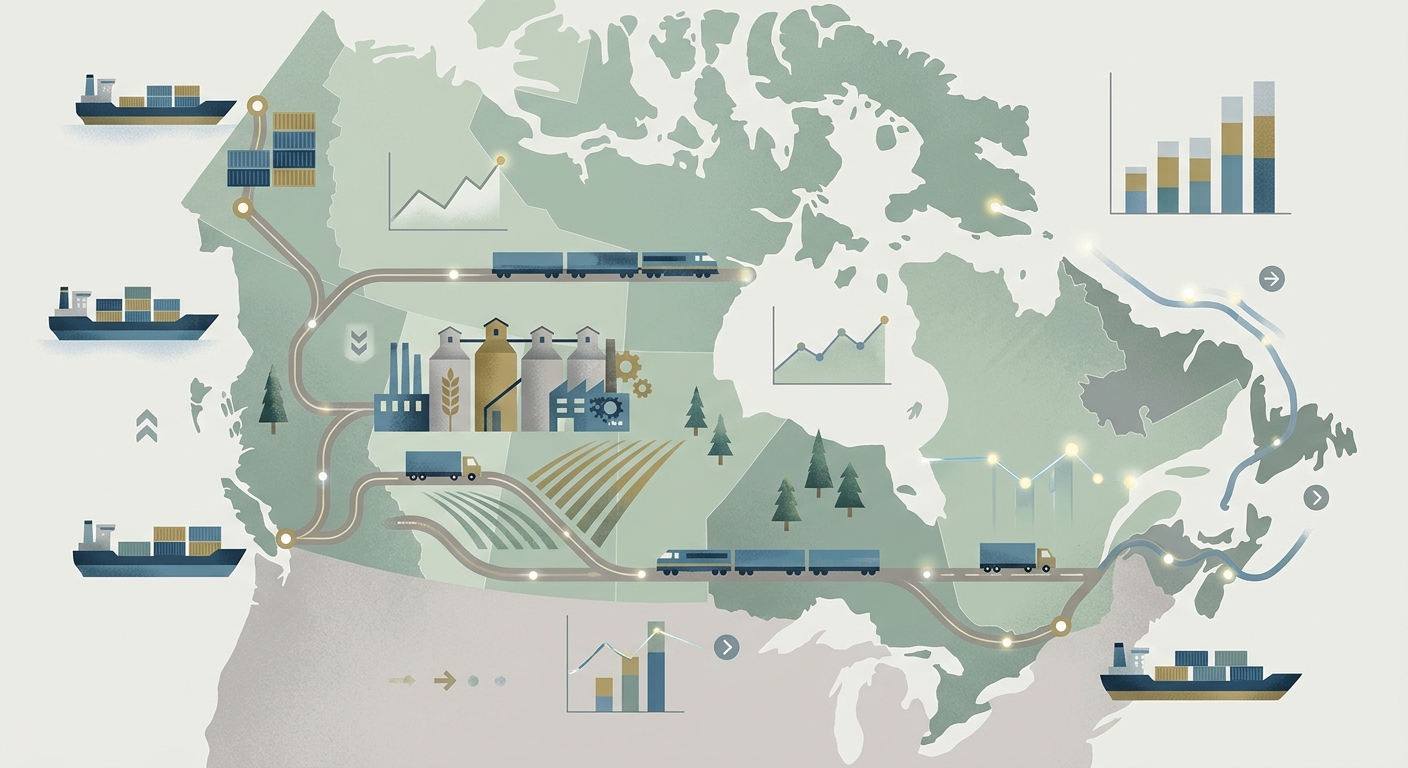
AI-generated illustration; not a photograph of the reported event.
- calendar_today November 13, 2026
Recent official statistics offer a detailed view of how Canadian businesses are integrated into both local and international supply chains, highlighting the growing complexity and challenges these businesses face in securing domestic supplies.
Canadian manufacturers remain central to the country’s internal trade, contributing one-third (33.3%) of total interprovincial trade in 2021, a figure nearly triple that of the second-largest sector. Yet, less than one-fifth (18.6%) of their output feeds internal Canadian trade, underscoring significant international integration and reliance on both national and global flows. These linkages are vital for companies that source domestic inputs or ship products nationwide [Statistics Canada: Challenges for domestic manufacturers].
Over time, Canada’s supply chains have been increasingly globalized. The share of imported intermediate inputs—goods used to produce other goods—rose to over 22% by 2019, up from just under 19% in 2007. This closer linkage to global markets is beneficial for productivity; for instance, manufacturing firms participating in global value chains report 10% higher labour productivity and 6% higher wages on average compared to non-participants [Statistics Canada: Tracking Canada's Evolving Supply Chain Links].
However, this global integration exposes businesses to new risks. According to recent data, nearly one-fifth (20.6%) of manufacturing businesses expected at least one supply chain-related obstacle in early 2025, with 10% anticipating difficulty acquiring inputs from within Canada. Labour disputes affecting transportation and logistics were cited by over one in five (21.6%) manufacturing businesses as a recent disruption, with 16.8% affected by disputes at the supplier level. Additional cited disruptions include international geopolitical events and natural occurrences [Challenges for domestic manufacturers].
Transportation costs are another top concern: more than a quarter (25.7%) of manufacturers expected transportation-related expenses to be an obstacle for their business in early 2025. Meanwhile, selling goods to other provinces was cited as a challenge by 5% of manufacturers—more than double the rate for overall businesses. Manufacturing businesses are also more likely to outsource delivery driving and errands, with 20.4% reporting this practice compared to 9.1% for all businesses [Challenges for domestic manufacturers].
From a broader perspective, supply chain vulnerabilities have been highlighted by recent disruptions, impacting both international and domestic supply sources. For small- and mid-sized firms, risks are amplified: the number of suppliers per imported intermediate input has been declining since 2002. The average small firm now has fewer than two suppliers per imported product, with roughly 80% relying on just one supplier—making them vulnerable to single-point failures [Tracking Canada's Evolving Supply Chain Links].
Despite these challenges, initiatives are underway to improve supply chain resilience and logistics data infrastructure, including efforts to enhance internal trade measurement and support for freight efficiency and capacity planning. These steps aim to enable more effective risk assessment and response strategies for Canadian businesses navigating today’s hybrid supply chain environment [Tracking Canada's Evolving Supply Chain Links].