AI-generated illustration; not a photograph of the reported event.
- calendar_today October 21, 2026
Grande Prairie Students Stage Walkout Over Teacher’s Social Media Post
In mid-October, dozens of students walked out of St. John Paul II Catholic School in Grande Prairie, Alberta, to protest a teacher’s controversial social media post about residential schools. The demonstration occurred following a Facebook post by social studies teacher Amy Davidson on September 30—Canada’s National Day for Truth and Reconciliation—sharing a statement from People’s Party of Canada leader Maxime Bernier. The post claimed that “no bodies were found in Kamloops” and referred to the residential school “genocide” claim as a hoax. Davidson added her agreement to the post, writing, “Hear, hear.”
Students and Community Respond to Teacher Controversy
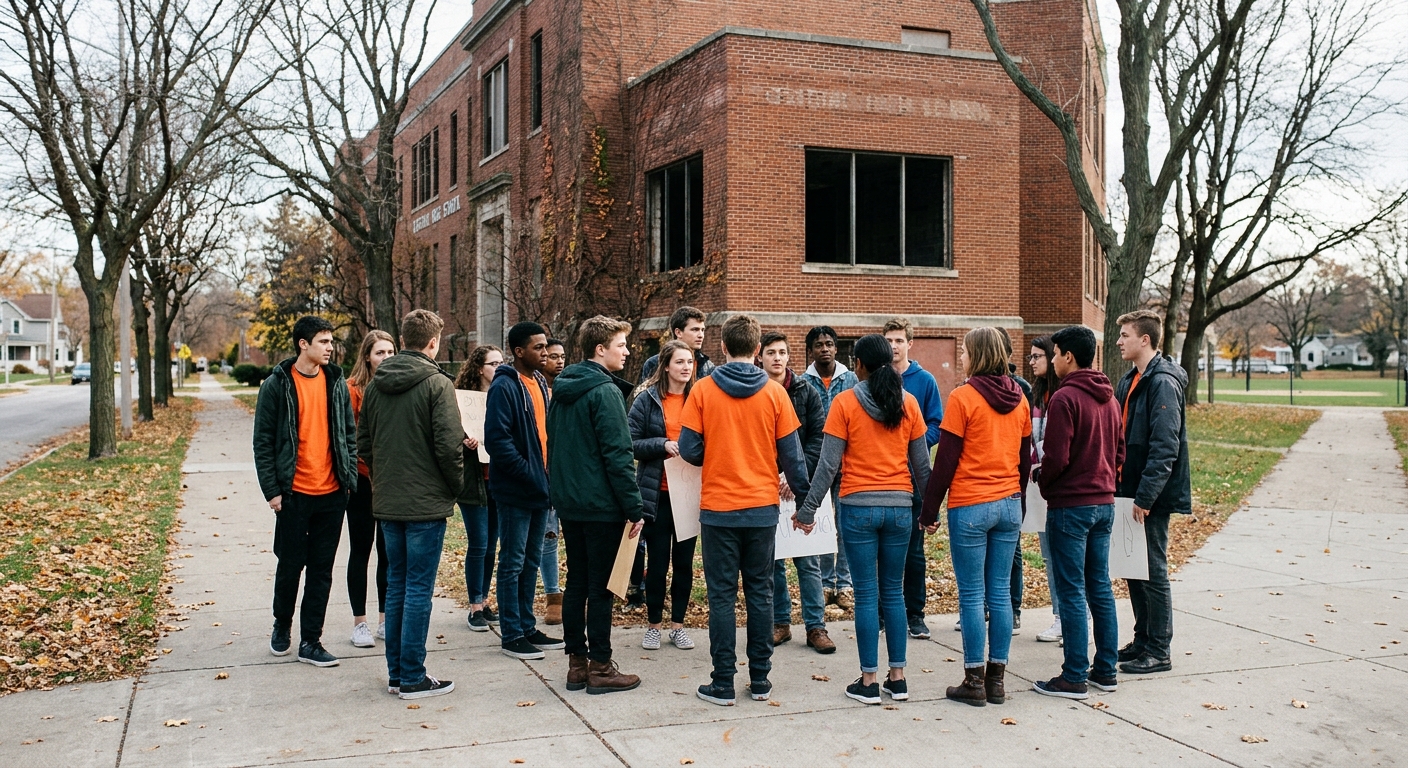
The walkout took place on October 13 as several dozen students aimed to raise awareness about what they saw as inappropriate conduct by a teacher. Parents and community members supported the students with hot chocolate, doughnuts, and encouragement. Critics of Davidson’s post, including Grade 12 student Isobel Knopf, expressed concern about the compatibility of such public statements with the teaching of Canadian curriculum on residential schools. “I just feel like making these broad claims on social media…and then coming into classrooms and teaching these things that are now parts of our curriculum is honestly baffling and should not be allowed,” Knopf said to CBC News.
Teacher Responds to Backlash
Amy Davidson, who has taught in Grande Prairie for about five years, explained to CBC News that she did not intend to deny the abuses of the residential school system. “I am not a residential school denialist, which many people have framed me as,” Davidson stated, clarifying that her post specifically addressed claims regarding the presence of mass graves at the Kamloops residential school site. Davidson indicated she had received over 100 comments—many critical—and said she was ordered by the Grande Prairie and District Catholic School Division (GPCSD) to remove her post, which she declined to do. Following this, she said she was unassigned from teaching, though she remains on payroll, and was scheduled to meet with the division and a representative from the Alberta Teachers’ Association (ATA) on October 19.
Families Share Personal Impact and Support for Protest
Grade 12 student Airianna Bayne, who is Kaska Dena, described the teacher’s post as especially distressing given her grandmother’s attendance at Lower Post Residential School in northern British Columbia. “Even if my grandma wasn’t Indigenous, it’s still so wrong,” Bayne said. Her grandmother, Ann Maje, supported the walkout, explaining that her own time at residential school was “horrific” and describing it as “more like a prison camp” than a place of education. Maje praised the students’ willingness to stand up for their beliefs, saying, “It gives me a lot of hope that our youth aren’t going to stay silent on issues of racism and denialism towards Indigenous people.”
Division and Community Leaders Emphasize Dialogue and Responsibility
The GPCSD declined to comment on Davidson’s employment situation but stated its commitment to truth and reconciliation and to “honouring the experiences of residential school survivors.” The division noted that it believes students “should feel empowered to express their perspectives, advocate for what they believe in, and engage in respectful, peaceful dialogue.” Lindsy Coney, a youth program coordinator at the Grande Prairie Friendship Centre and former teacher, attended the protest and expressed admiration for the students’ conduct. She emphasized the importance of teachers being mindful about their social media presence: “Students are going to see that and your school community is going to see that—and I think we’re being extremely naive if we don’t acknowledge that.”
Context: Truth and Reconciliation in Canada
The Truth and Reconciliation Commission of Canada has described the residential school system as a form of cultural genocide, and in 2022 the House of Commons also recognized residential schools as genocide. The discovery of potential gravesites at the Kamloops Indian Residential School in 2021 reignited national discussion, though the First Nation involved has not yet decided whether to excavate the site. The ongoing debate highlights the sensitivities around Canada’s history with residential schools, truth and reconciliation, and the responsibilities of educators both inside and outside the classroom.
Source: cbc.ca.