
- calendar_today August 15, 2025
Is Species Worth Watching in 2025? Here’s What Still Works
Last month, the film community said goodbye to actor Michael Madsen. He is best known for his grizzled, tough-guy roles in movies like Reservoir Dogs, Kill Bill, and Donnie Brasco, to name a few. While Madsen’s prolific acting career has him associated with cult favorites and genre masterpieces, one of his early 1990s roles that seems to be going under the radar was as a black ops mercenary tracking down a half-human, half-alien hybrid in Species. This summer sci-fi monster flick turns 30 years old, and it’s worth revisiting for many reasons—not just nostalgia.
Species was a 1995 sci-fi horror movie directed by Roger Donaldson (No Way Out, The Bounty). It came out in theaters when the ’80s revival was in full swing and at a time when Hollywood was both drowning in monster movies and wracked by conspiracy-fueled alien panic. The film is a little like Alien 3 with clones, or a lighter version of Predator 2 with more T&A and body horror. The story opens with two signals picked up by the U.S. government from outer space: one has information on a cutting-edge, highly efficient fuel source, while the other provides detailed instructions for how to splice alien and human DNA. (Yes, the government does this.) The hybrid experiment is run by Dr. Xavier Fitch (Ben Kingsley), and the result is Sil, played as a youngling by Michelle Williams. The government scientists expected to create a quiet, manageable organism. The result was very different.
Sil is a hybrid organism that quickly develops into adolescence in a matter of months (she takes on the appearance of a 12-year-old girl in just three months). However, not everything is perfect with the experiment. Sil has aggressive nightmares, and there are telltale signs that she may be a bit more “difficult to control” than was originally planned. When Fitch decides to call it quits and inject cyanide into Sil’s holding cell, something goes wrong: she escapes, and the hunt is on.
Needless to say, Fitch and his team of scientists do not take Sil’s disappearance lightly. To track her down, Fitch and the government contract a crew of experts that includes Preston Lennox (Madsen), a mercenary and skilled black ops agent; molecular biologist Dr. Laura Baker (Marg Helgenberger); Dr. Stephen Arden (Alfred Molina), an anthropologist; and Dan Smithson (Forest Whitaker), an empath with a mysterious past who can feel Sil’s emotions. The team begins a cat-and-mouse game that moves them from California to the East Coast and back again as Sil works her way to Los Angeles, where she will go on a sex-obsessed killing spree to find a mate and reproduce. She is smart, resourceful, and all instinct. As Sil leaves a trail of dead bodies behind her—including a train tramp, a nightclub casualty, and a lover who is ultimately put to use to capture her—the team works to stop her before she can create a new brood that will reproduce at a terrifying rate.
Designing a Monster That Seduces, Feeds, and Kills
Species has some memorable aspects to it, but one of the most exciting and prominent was the design of the titular alien hybrid. Species’ monster was designed by surrealist and artist H.R. Giger, who was well-known for his work on Alien and Silent Hill, among other properties. He gave Sil an alien anatomy that “appears to be a liquid, organic metal, highly complex and full of ducts and canals, somewhat resembling the natural forms of the female sexual organs,” as well as cybernetic detailing in her nipples and mouth, which also serves as her primary weapon. Giger called Sil “an aesthetic warrior, also sensual and deadly.”
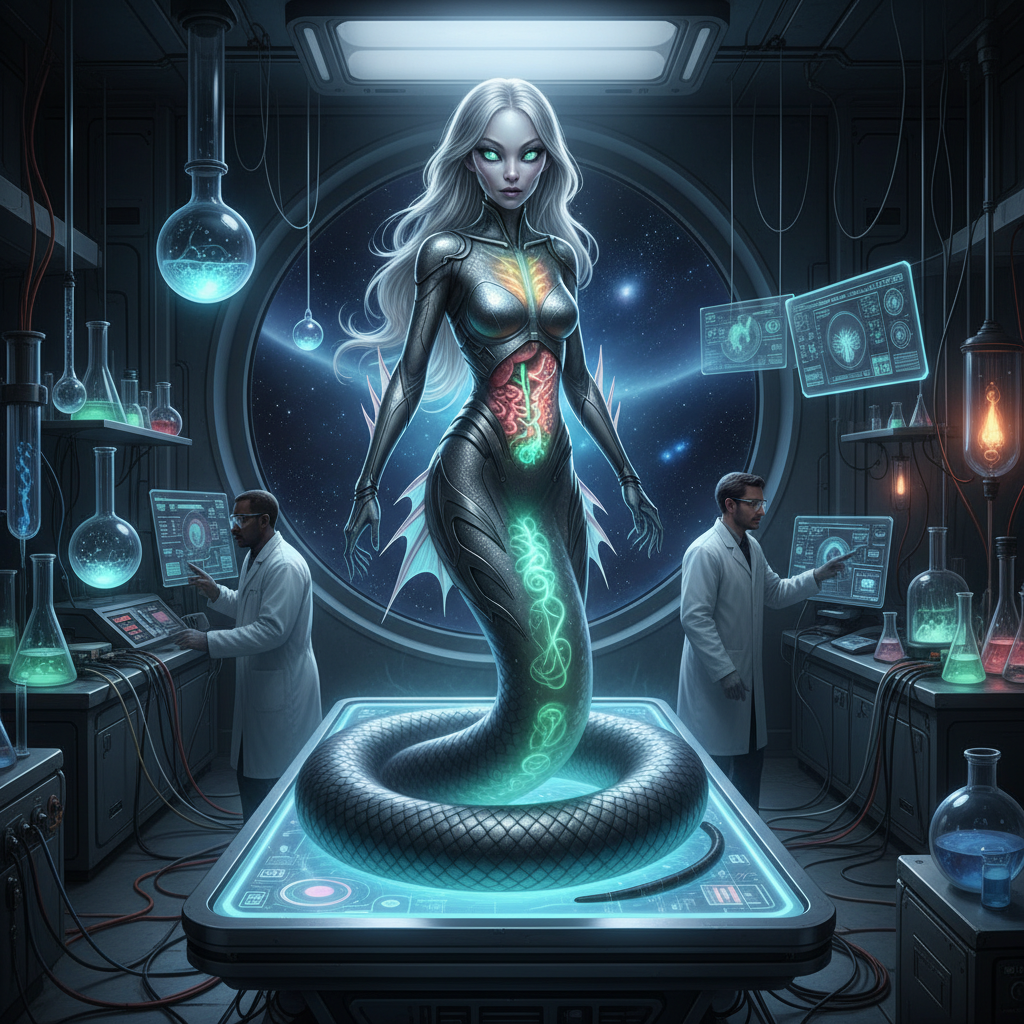
Visually, the design is stunning. Giger describes Sil’s final form as having “transparent skin, with, underneath the surface, something like a glass body but with carbon inside.” Giger had planned for Sil to go through three stages of alien evolution. Because of time and budgetary constraints, only two survived: the cocoon she wraps herself in to transform, and the final body she morphs into as the film draws to a close, a tall and serpentine female alien.
Giger was not pleased with the final cut of Species, though. He resented the movie’s similarities to his earlier work on Alien, including its “punching tongue” and the climactic birth scene of the alien on a human’s chest, which he felt was too similar to his own “chestburster” scene in Alien. Giger went so far as to call the producers and make sure the filmmakers didn’t kill Sil off by letting her be set aflame, saying that the concept “was too reminiscent of Aliens 3 and Terminator 2.”
Species was an Experiment That Worked, Sort of
Species was mostly met with a lukewarm critical response. Many of the characters were one-note, the script had its issues, and the dialogue was occasionally clunky. Kingsley’s portrayal of the amoral Fitch was unconvincing, and Whitaker’s character, the empath, had little to do other than wander about the narrative grimacing and saying what the audience was already thinking. The thematic elements of the film were touched on—the ethics of bioengineering, the contact with extraterrestrials, and the maternal urge—but never fully mined. Screenwriter Feldman found the inspiration for Species in an article he had read in the ’80s by Arthur C. Clarke, a futurist who had a side gig writing about alien possibilities for Omni magazine. Clarke made the case in his article that, due to the prohibitive speed of faster-than-light travel, it was impossible for extra-terrestrials to have or to make contact with Earth. Clarke went on to ask: What if aliens did attempt to make contact with Earth, but used blueprints to create something organic rather than a robot?
The result was a movie that tried to be a science-fiction thriller, a slasher, and a cautionary tale all rolled into one. It has never had the cachet of Aliens, or, a few years later, The Terminator. However, it does have its cult following—and for very good reasons. The movie’s odd mix of sci-fi and softcore horror is strangely captivating. Henstridge’s performance is mesmerizing and cold, Madsen is as badass as ever, and Giger’s monster is hard to forget.
Species is both a time capsule for what science fiction looked like when aesthetics could overshadow everything else and a sign of the bizarre, genre-bending roles that defined a career for a man like Michael Madsen.