
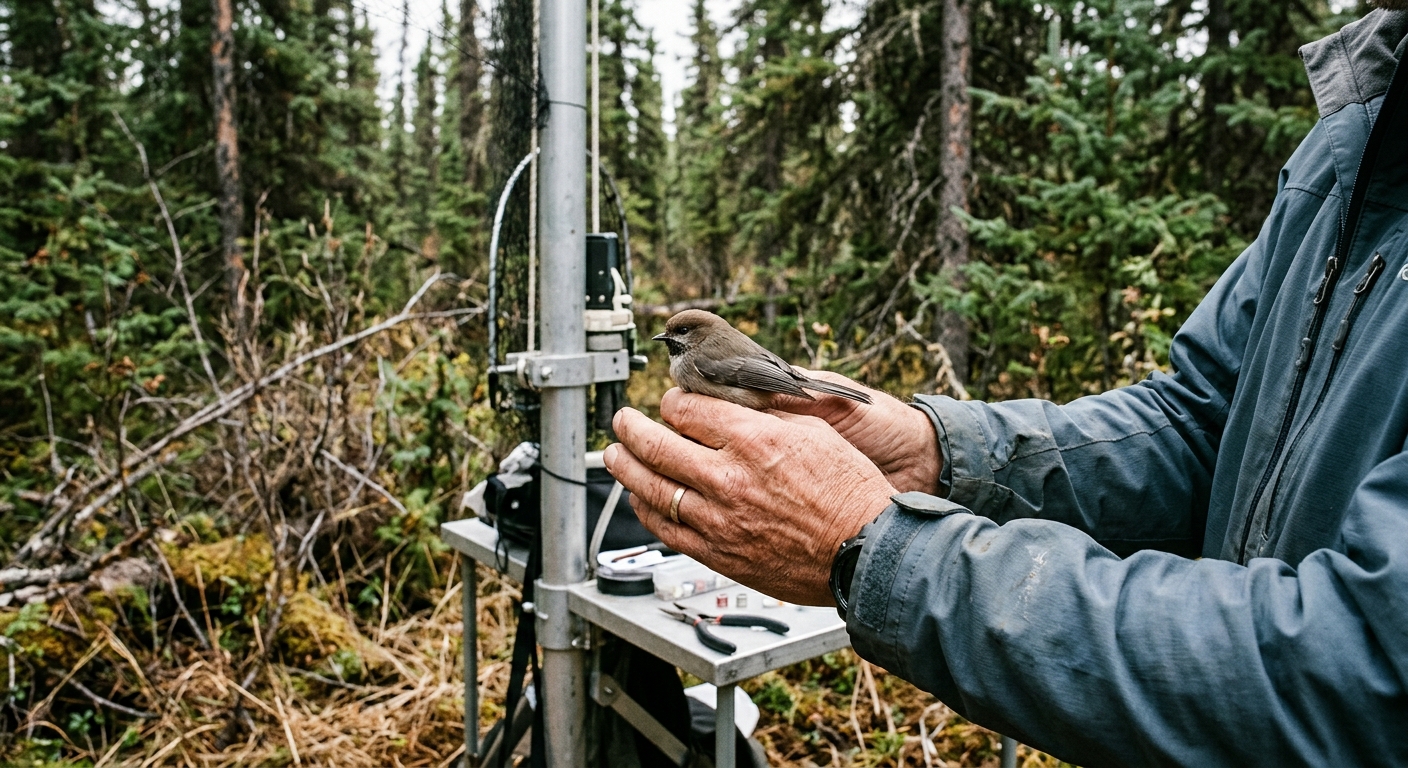
AI-generated illustration; not a photograph of the reported event.
- calendar_today October 11, 2026
Wood Buffalo Wildlife Research Institute Leads New Initiative
The Wood Buffalo Wildlife Research Institute (WBWRI), based in Fort McMurray, has launched long-term studies focused on monitoring bird populations across the oilsands region. As the only non-profit organization of its kind in the area, WBWRI aims to deepen research and enhance community engagement through citizen science initiatives.
Bird Banding and Volunteer Involvement
On September 29, 2026, Calgary-based ornithologist Ethan Denton was observed near Fort McMurray carefully attaching an identification band to a dark-eyed junco, a small songbird. This process, part of a broader bird banding project hosted by WBWRI, enables researchers across North America to track migration patterns and gather vital data about these birds. Gender and measurements of each bird are recorded before they are safely released.
Ken Foster, a founder of WBWRI, oversees much of this work and frequently explains the bird banding methods to volunteers. Foster highlighted the importance of these efforts, stating, “Programs like this define which birds are declining [and] by how much and hopefully what we can do to help reverse it.” The institute also encourages participation from local volunteers who help with monitoring and data collection, embodying a true citizen science approach.
Ongoing Research and Observed Trends
While organizations such as the Oil Sands Monitoring Program and the Alberta Biodiversity Monitoring Institute have conducted long-term research in the region, the creation of WBWRI in 2024 by Foster and his wife, Christine Godwin, aims to provide added stability and local outreach. Foster’s prior work through his consulting company, Owl Moon Environmental Inc. (OMEI), revealed that bird species are responding differently to environmental changes in the oilsands area.
Data collected by Foster indicates that certain songbird populations, including the least flycatcher and northern waterthrush, have declined by as much as 90 percent over the past 15 years. These declines are attributed mainly to habitat changes from wildfires, industrial developments, and shifting conditions along migration routes. A decrease in flying insects, a critical food source, has also played a role. Conversely, some generalist species, such as clay-coloured sparrows, are thriving in reclaimed or regrown former oilsands and boreal forest habitats.
Local and Broader Scientific Impact
Ryan Campbell, a recent high school graduate, completed a summer internship with WBWRI and shared how the experience transformed his perspective on birds and conservation. “They’ve got me buying binoculars, setting up eBird accounts. I'm definitely a bird person, and for that I'm eternally grateful,” Campbell remarked.
The importance of integrating local studies into broader datasets was emphasized by Erin Bayne, a biology professor at the University of Alberta. Bayne noted that while certain species seem stable in North America overall, local data from projects like Foster’s can highlight more acute regional declines and guide governments and organizations in conservation efforts.
Expanding Research and Future Goals
Beyond bird banding, WBWRI has installed an automated tracking tower as part of the Motus Wildlife Tracking System, a network spanning both North and South America. This technology will help track animals fitted with radio transmitters, and WBWRI hopes to raise additional funds to tag more birds in the region.
Additionally, the organization is beginning to monitor local bat health and aspires to develop volunteer programs for wildlife rehabilitation around Fort McMurray. Foster summarized the significance of these initiatives: “Programs like this put a number to change that we’re all sensing. We all sense fewer birds.”
Continued Effort Towards Wildlife Conservation
The work of WBWRI stands as a testament to grassroots efforts in wildlife research, bird monitoring, and conservation. By involving citizens and collaborating with other scientific bodies, the institute seeks to provide crucial data on bird populations and inform strategies to address songbird decline amid ongoing changes in the oilsands region.
Source: cbc.ca.




